A KNOWLEDGE BASE DEVELOPED WITH THE SUPPORT OF THE CNC, AS PART OF THE CALL FOR PROJECTS LES UNS ET LES AUTRES.


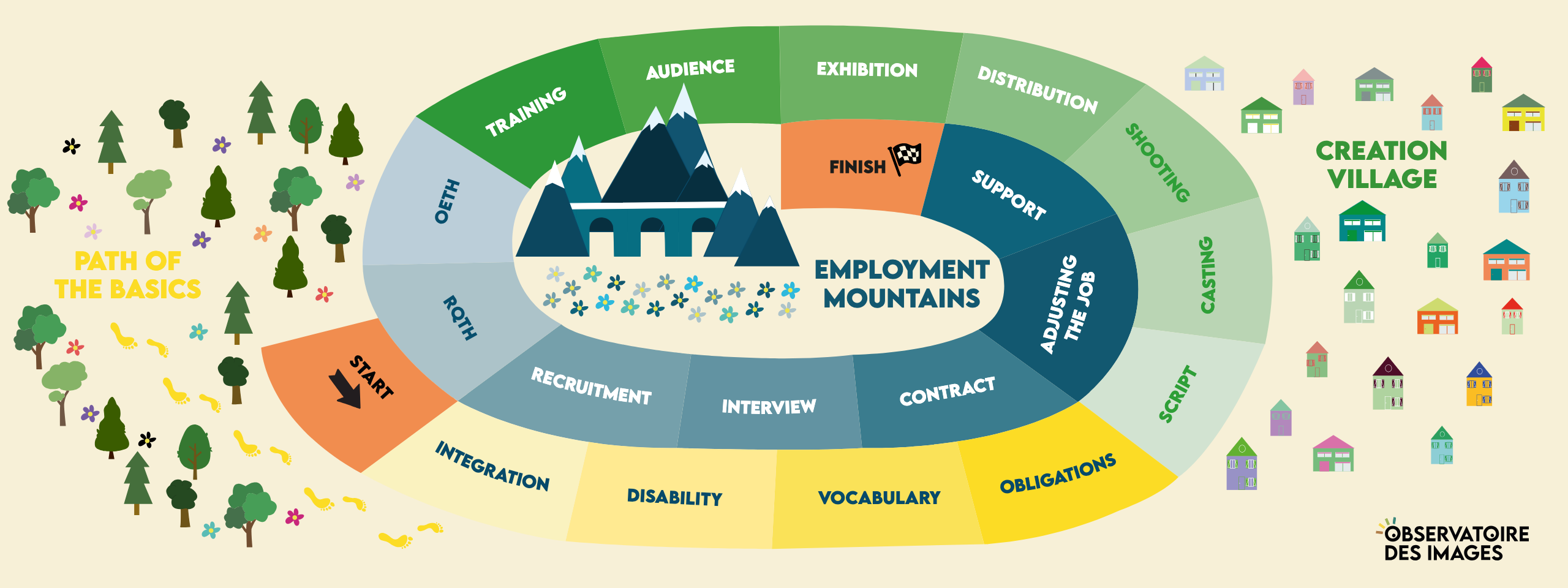
Start
How can we help better integrate disabled people into our industry, whether in the office or on set, in front of or behind the camera?
People with disabilities are largely excluded from the audiovisual and film sector: a sector that nonetheless creates and conveys representations for the rest of society.
16% of French people are disabled, yet only 0.6% of people appearing on TV are perceived as disabled*. Of these, 67% are men and 90% are perceived as white*. 80% of disabilities are not visible and only 15% of disabled people have been disabled since birth or before the age of 16. Relatives, families, friends, coworkers of disabled people… an even greater number of people are directly concerned and face these issues every day without being represented.
Beyond a legal, administrative or financial imperative, integrating disabled people into our industry means opening up to the reality of a society in which not everyone is white, heterosexual, cisgender or non-disabled.
This involves learning, adapting and evolving, but also being supported and helped by specialized organizations.
The content of this knowledge base aims to provide all players in the sector, whoever they are (writers, producers, broadcasters), with the tools and contacts they need to move toward better integration of disabled people and to transform their practices for the long term.
Source: Barometer by Arcom, La représentation du handicap à l’antenne et l’accessibilité des programmes de télévision aux personnes en situation de handicap – Rapport 2021
Level 1: Getting informed, the basics of disability in the audiovisual sector
Why is it important to integrate people with disabilities into the audiovisual and film sectors?
People with disabilities are under-represented among media and audiovisual employees. Beyond on-screen appearances, studies show that the inclusion rate of people with disabilities in European media ranges from 1 to 8% depending on the country, while 16% of the population is disabled: this figure remains far too low.
This lack of integration of people with disabilities is a problem, because these are the very people who will take part in building images, and therefore representations. Through their daily work, members of the audiovisual and film sector shape the representations that circulate in society, while being largely influenced by it. There is thus a continuum between the sector’s employees and the representations that result from their work, and one can imagine that improving the employability of people with disabilities behind the camera will lead to better representations, and vice versa.
What counts as a disability?
In France, disability is defined by Article L. 114 of the Social Action and Families Code (code de l’action sociale et des familles), stemming from the law of February 11, 2005. A disability is thus: “any limitation of activity or restriction of participation in society experienced in their environment by a person due to a substantial, lasting or permanent impairment of one or more physical, sensory, mental, cognitive or psychological functions, a multiple disability or a disabling health condition”.
There is a wide variety of disabilities, which can be classified into several families*:
- motor disability. This concerns people who have difficulty moving around, making certain movements or carrying weight. They may also have trouble maintaining or changing position. Contrary to popular belief, less than 5% of people with motor disabilities use a wheelchair;
- neurodevelopmental disorders. These include:
- autism spectrum disorder
- psychosocial disability, which covers various personality disorders. Generally, these do not affect intellectual abilities, but they have consequences on reasoning, communication and behavior;
- intellectual disability: this relates to an intellectual impairment. It results in difficulties with thinking, communication and decision-making;
- cognitive disability: this leads to attention or perception disorders, such as dyslexia;
- sensory disability: this relates to sight (total or partial loss of vision) or hearing (total or partial hearing loss, tinnitus);
- disabling illnesses such as cancer, HIV, allergies or diabetes. They can lead to motor problems, fatigue or constraints related to treatment.
80% of disabilities are not visible and only 15% of disabled people have been disabled since birth or before the age of 16. In France, it is estimated that 16% of the population has a disability – a ratio comparable to those observed in other countries such as the United Kingdom, the United States or Germany.
Source: National Association for the Management of the Fund for the Professional Integration of Disabled People (Agefiph)
What vocabulary is appropriate to use with people with disabilities?
When you first start learning about the subject, it is common to wonder about the right words to use: disabled person, impairment, person with a disability? There is no specific recommendation, and two different people will give two different answers. The United Nations, for example, uses the term “persons with disabilities”. The best solution is still to ask the people concerned, which shows a certain attentiveness and tact.
To find out more:
- guides and lists to adapt your vocabulary can be found on the website of the association La compagnie des aidants (in French) or on that of the American association Respectability.
As an employer, what are my obligations?
Since January 1, 2020, there has been an employment obligation for disabled workers. All companies with more than 20 employees must directly employ 6% people with disabilities (5% in Mayotte), failing which they must pay an annual financial contribution to the National Association for the Management of the Fund for the Professional Integration of Disabled People (Agefiph) of around €4,000 excl. VAT per disabled worker who should have been employed. For more information, click here.
Note: Although this legal obligation applies to a minority of companies in the audiovisual and film sector – most organizations have fewer than 20 employees – inclusion is everyone’s business and has a strong impact on the representations offered. For more information, click here.
Level 2: Reflecting on inclusion, from writing to distribution
What questions should you ask when writing / reading a script?
Disability is unfortunately too often absent from the screen, or else portrayed in a stereotyped way, associated with stigmatizing behaviors… when it could be integrated into stories without any need to dwell on it or make it a narrative issue.
To offer an authentic representation of people with disabilities, ask yourself the following questions*.
When writing a script:
- Can I call on someone in my circle or networks who has the disability in question and could share their experience and support me through the writing process, for maximum plausibility?
- Do I have enough information and knowledge about the disability to be included in the story to do so authentically?
When reading a script:
- If the content is intrinsically linked to the theme of disability or if a major character has a disability: did someone (writer, consultant) with the same type of disability take part in the writing?
- Have experts on disability issues (people with disabilities, medical staff, etc.) been consulted?
In all cases:
- Is disability portrayed in a positive, negative or neutral way?
- Is disability used as a plot device to move the story forward?
- Is disability used as a foil to show the empathy of a non-disabled person?
- Is disability integrated into a story arc rather than being a story arc in itself?
- As in life, disability can affect any character, regardless of their ethnic or social background, age, sexual orientation, etc.; is it handled inclusively?
- Is disability used to justify a character’s negative behavior, especially if they are an antagonist?
- Is disability used as a way to get laughs at the expense of the character concerned?
- Is the way disability is integrated into the story stigmatizing for people with disabilities?
- Does the story highlight the benefits of therapeutic support?
- Are tropes and stereotyped representations avoided?
When in doubt, do not hesitate to seek support from people with disabilities, experts or associations to offer an honest, non-stereotyped representation.
To find out more:
- lists of tropes related to representations of people with disabilities are available online, for example in French on the website of the sensitivity reading service Lecture sensible, or in English in the Ford Foundation white paper Roadmap for inclusions.
Source: MENTAL HEALTH CONDITIONS IN FILM & TV study, USC ANNENBERG
What questions should you ask at the casting stage?
The reality of the population is still too rarely shown in fiction. For it to be fairer, films and series must be inclusive in the sense of real-world representation: because not everyone is white, heterosexual, cisgender or non-disabled. Of course, this will not always be possible given the stories/projects, but it is a question that must be answered at every stage of the process, including casting.
Today, roles of characters with disabilities are mostly played by non-disabled actors. On American television, 95% of roles of characters with disabilities are played by non-disabled actors*. “Authentic casting”, i.e. roles of people with disabilities played by talent with a disability matching that of the role, mostly concerns the least recurring roles: in 71% of cases of authentic casting in TV series, these were roles appearing in fewer than 5 episodes*. You can rely on agencies specializing in representing talent with disabilities, or on associations, to find the right talent profiles, such as the Singularist agency or the Colette agency.
In general, you should consider casting people with disabilities in all types of roles, from leads to extras, whether or not they are written for people with disabilities. Disability will not necessarily be a subject in itself in the story, but simply a casting choice. You can have a character with a disability and make their problems universal, so that they speak to everyone! What really matters is avoiding stereotypes and clichés, because the representation of people with disabilities is often stigmatizing.
Also, keep an intersectional approach in mind: on French television, people with disabilities are still mostly men (67%) and perceived as white (90%)*, which does not reflect the reality of disability, which also affects women and racialized people. These figures reveal the extent to which people with disabilities are excluded from the sector and the need to transform practices significantly and for the long term.
When organizing castings, plan ahead for accessibility:
- logistics: check that the venues chosen for castings are accessible (location, no steps, elevator, adjustable lighting, etc.);
- process: do not hesitate to ask the talent’s agent to learn more about the etiquette to adopt and to anticipate specific needs, such as a sign language interpreter or a Braille transcription of a script.
Sources: American study Road Map for Inclusion; Ruderman Foundation Authentic Representation WP 2020; Barometer by Arcom, La représentation du handicap à l’antenne et l’accessibilité des programmes de télévision aux personnes en situation de handicap – Rapport 2021
How can I make my shoot inclusive?
When organizing shoots, you need to plan ahead for the accessibility of the various locations (set, catering, restrooms, rest areas, accommodation, etc.), of getting between them (transport, etc.) and of the technical equipment. Particular attention must be paid to the inside of accommodation and personal spaces (restrooms, showers, etc.).
To do this, ask talent and crew members ahead of the shoot about their needs and the support they require. A person with a disability may, for example, need an external support worker, a sign language interpreter, etc.
All dependent people (people with disabilities, children, elderly people, etc.) have the same right to a support worker. For example, on a shoot, the support worker’s travel, accommodation and meal costs must be covered by the production.
As answers sometimes come late (or even after the shoot), it is essential to keep in mind that human obligations come before economic ones: for example, do not wait for a positive answer on funding before arranging the support worker.
How can I make the distribution of my film / series / … inclusive?
The accessibility of a film or series to people with disabilities depends on subtitles for the deaf and hard of hearing (SDH), amplification (HI) and audio description (AD). A few tips to improve them:
- Frame shots with subtitles in mind;
- Produce the subtitles during editing and test them, like the other elements, with people with disabilities;
- Set aside time and budget for subtitles for the deaf and hard of hearing and for audio description.
In terms of costs, Arcom gives the following estimates of the average hourly cost: from €249 to €625 excl. VAT for subtitling a program; more than €2,500 for sign language translation; between €1,500 and €3,600 for audio description. The CNC has set up financial support to broaden the range of films accessible to audiences with disabilities. For more information, click here.
To find out more:
- the Ciné-Sens website offers guide sheets on audio description and subtitling in its Ressources section;
- the guide Cinéma et accessibilité, published by the French Ministry of Culture in November 2018, can serve as a reference for producing subtitles for the deaf and hard of hearing and audio description;
- the toolkit A Toolkit for Inclusion & Accessibility: Changing the Narrative of Disability in Documentary Film, based on the American documentary Crip Camp, is a benchmark for accessibility and inclusiveness; published in February 2021 by FWD-Doc.
How can I make the exhibition of my film / series / … inclusive?
14% of people with disabilities say they never go to the cinema, yet 84% of them say they are receptive to accessibility features in theaters. The main obstacles to their cinema attendance are: the lack of accessibility features offered for films, such as audio description or subtitles, difficulty getting around, and greater viewing comfort at home*. Yet theaters today have many ways to make the exhibition of a film inclusive.
To screen adapted versions of films, technical solutions or adaptive equipment may be needed (induction loop, individual sound receiver, app…).
It is also necessary to make arrangements so that people with disabilities can access the venues or platforms where the version is shown.
- When the film is screened at a festival or in theaters, make sure it is in an accessible version and that the venues themselves are fully accessible (access to screening rooms, restrooms and panel discussions; access to the stage and interpreters for Q&As, etc.).
- In the case of online distribution, on platforms or on-demand audiovisual media services (SMAD), check the standards of the players, in particular that they allow a second audio track to be added*.
Remember also to inform the different audiences about accessibility, the existence of these adapted screenings and their times (using the appropriate terms, pictograms and communication materials).
The CNC has set up financial support to broaden the range of films accessible to audiences with disabilities. For more information, click here.
Beyond a social and ethical imperative, including people with disabilities in the creation and consumption of content can represent a business opportunity and a chance to reach a new audience. For more information, click here.
To find out more:
- Inclusiv, in partnership with the CST & Retour d’Image, Ciné Sens and the CST, offers a series of training courses to promote the inclusion of people with disabilities in movie theaters, from the desire to go to the cinema (communication, access to information, programming) to arrival at the theater (welcome, mediation, technical aspects);
- the association Ciné-Sens offers an e-learning module covering the questions raised by making screenings accessible to people with sensory disabilities;
- the guide Cinéma et accessibilité, published by the French Ministry of Culture in November 2018, can serve as a reference for working toward exhibition and distribution that are accessible to people with disabilities.
Sources: Inclusiv questionnaire; Arcom 2021 report, La représentation du handicap à l’antenne et l’accessibilité des programmes de télévision aux personnes en situation de handicap
How can the inclusion of people with disabilities help the audiovisual industry reach a wider audience?
Beyond a social and ethical imperative, including people with disabilities in the creation and consumption of content can represent a business opportunity and a chance to reach a new audience.
A recent study shows that people with disabilities (especially deaf and hard-of-hearing people) face a real lack of accessibility in the audiovisual industry (especially in entertainment) but want this type of content and could spend more money on it*.
Moreover, working with people with disabilities makes it possible to connect with disability communities, which can increase the audience for a film or series. For example, for the American documentary Crip Camp, a series of online workshops on various disability-related topics welcomed more than 10,000 people.
To find out more:
- the toolkit A Toolkit for Inclusion & Accessibility: Changing the Narrative of Disability in Documentary Film, based on the American documentary Crip Camp, is a benchmark for accessibility and inclusiveness, published in February 2021 by FWD-Doc;
- the association Ciné-Relax offers accessible cinema screenings for people with disabilities;
- the association Ciné-Sens offers an e-learning module covering the questions raised by making screenings accessible to people with sensory disabilities, and lists every month the films with accessible versions with audio description (AD), subtitles for the deaf and hard of hearing (SDH) and amplification (HI).
Source: AbilityNet, Businesses are missing out on the purple pound (2019)
How can audiovisual training programs be made accessible to people with disabilities?
Audiovisual and film training organizations have a particular role to play in the representation of people with disabilities: in creating content and in raising students’ awareness of these issues. For more information, click here.
Beyond teaching, these schools obviously need to be made accessible. Disability raises extremely different issues depending on the situation of the person concerned: as with adapting a job, the most important thing is to understand clearly the type of disability involved and the needs associated with it, while remaining open to introducing new practices on a “case-by-case” basis within the institution. This is what La Fémis does: a few years ago it launched a policy for welcoming and including people with disabilities.
It is also necessary to highlight concrete elements showing that the organization supports the development of a student with a disability, so that applicants can consider these programs / get in touch with them. For example, by spelling out the accessibility of the premises, the specific equipment available to ensure the training runs smoothly, the possibility of special arrangements for an entrance exam, etc.
To find out more:
- watch the Ressource Handicap Formation webinars on the Agefiph website (legal framework, designing an accessible classroom, inclusive teaching, etc.);
- it is also possible to take the disability officer training offered by Agefiph (a module particularly recommended by La Fémis).
Level 3: Understanding in depth the mechanisms, support and administrative procedures of employment
Obligations
As an employer, what are my obligations?
Since January 1, 2020,
- all companies, whatever their size, must file a declaration of employment of disabled workers (DOETH);
- all employers, public or private, with at least 20 staff / employees are required to directly employ 6% people with disabilities (5% in Mayotte), a percentage that may be raised every 5 years. When a company crosses the 20-employee threshold, it has 5 years to comply with the employment obligation for disabled workers (OETH);
- if a company does not reach this threshold, it is required to pay an annual financial contribution to the National Association for the Management of the Fund for the Professional Integration of Disabled People (Agefiph), of around €4,000 excl. VAT per disabled worker who should have been employed;
Note: Although this legal obligation applies to a minority of companies in the audiovisual and film sector – most organizations have fewer than 20 employees – inclusion is everyone’s business and has a strong impact on the representations offered. For more information, click here.
- until 2024, indirect employment (through sheltered work establishments or services, adapted companies, self-employed disabled workers) does however make it possible to reduce the contribution to Agefiph (30% of expenses excl. VAT being deductible up to 50% of the contribution if fewer than 3% of workers are disabled; deduction up to 75% if more than 3% of workers are disabled);
- the administrative procedures for hiring a person with a disability are simplified, and are carried out via the nominative social declaration (DSN), as for any employee.
Since the law of July 12, 1990, refusing to hire, dismissing or sanctioning an employee because of their state of health or disability is a criminal offense. Only the occupational physician can decide whether or not a candidate is fit for a job. If the candidate is found fit, the employer may not base any decision on the candidate’s state of health or disability.
Note: People with disabled worker status are those who have obtained recognition of disabled worker status (RQTH). Disabled workers covered by the OETH are listed on the website of the Ministry of the Economy, in the employment section. To date, there is no way of including people with disabilities who do not have RQTH in a company’s statistics. However, some tools have been developed, such as the Diamond Diversity Monitoring System in the United Kingdom, an anonymous form sent to all members of the audiovisual industry in order to centralize diversity statistics for the sector. It may therefore be possible to set up a similar system by sending an anonymous questionnaire to all employees to establish your company’s diversity statistics, thus including people with disabilities who do not have RQTH.
What is the employment obligation for disabled workers (OETH)?
All employers, public or private, must comply with the employment obligation for disabled workers (OETH) once they have at least 20 staff / employees. This obligation requires them to employ disabled workers in a proportion of 6% of their total workforce.
All employers, including those with fewer than 20 employees, must declare the number of jobs held by a disabled worker to show that they comply with their employment obligation.
For more information, click here.
What is recognition of disabled worker status (RQTH)? What are the conditions for obtaining it?
RQTH is an administrative decision that grants disabled workers a status entitling them to specific support.
RQTH is granted to anyone whose relationship to employment is complicated by a health problem whose effects last more than a year (any type of disability, including endometriosis, diabetes, low back pain…). You must be 16 or older.
It is obtained through a voluntary application by the person concerned, made to the departmental center for disabled people (MDPH) of their département. The RQTH assessment takes between 1 and 9 months. It is valid for a limited period of 1 to 10 years, except in the case of irreversible disability, where it can be granted permanently.
Some people do not need to apply for RQTH to benefit from it:
- victims of work accidents or occupational diseases resulting in a permanent incapacity of at least 10% who receive an annuity from a compulsory social protection scheme;
- holders of an invalidity pension;
- holders of an invalidity card;
- recipients of the disabled adult allowance (AAH).
Note: There is no obligation to inform one’s employer (or any other organization a person with a disability may be in contact with) that RQTH has been obtained. However, it can make it possible to communicate about one’s disability so that it is better taken into account.
To find out more:
- see the website of the Ministry of the Economy, in the Emploi et handicap : RQTH section, or the government website Mon parcours handicap.
What rights does RQTH open up?
Recognition of disabled worker status (RQTH) gives access to a set of measures that help people stay in employment or find a new job, such as training and professional integration support. Training can be funded and paid.
The website of the Federation of Associations Managing Rehabilitation Establishments for Disabled People (FAGERH) lists the training programs accessible to people with disabilities, by sector of activity. There is no training specific to technical jobs in the audiovisual and film sector, but there are courses in computer graphics and administrative jobs.
RQTH also gives access to the Emploi Accompagné (supported employment) scheme, which allows the disabled person to be followed by a coach in their job search and/or in keeping their job.
On the employer side, RQTH recognizes disabled worker status and therefore counts toward the 6% employment obligation for disabled workers. For more information, click here.
Recruitment
Are there companies / organizations to turn to in order to recruit people with disabilities in the audiovisual and film sector?
To recruit people with disabilities in the audiovisual and film sector, you may need to look for:
- Information: Cap emploi agencies are the go-to organizations for information on recruiting a person with a disability, although they are not specific to the audiovisual and film sector. These specialized placement organizations (OPS) serve people with disabilities who need specialized and enhanced support, as well as employers (public and private) for recruiting people with disabilities and keeping them in employment. It is a free, local and fully individualized service. The services offered to employers focus on support and follow-up, including information on the professional integration of a person with a disability, defining a suitable recruitment process and presenting targeted applicationsNote: Cap emploi agencies are currently being brought closer to Pôle emploi. In 2025, there will be a single service called “France Travail”.
- CVs/profiles: As with any recruitment, hiring a disabled person is first and foremost a question of skills, not disability. Most jobs can be held by a disabled person, which is why an inclusive approach is needed for all job offers. For more information, click here. In the audiovisual and film sector, you may nevertheless need to look for specific profiles of people with disabilities. In this case, it is advisable to turn to specialized companies, such as the Singularist agency or the Colette agency, to find artistic talent. You can also tap into alumni networks in the sector by contacting training organizations: the JARIS training program offers people with disabilities a 4-month course dedicated to careers in journalism, audiovisual, film and video games; or the audiovisual production company Séquences Clé, which is made up mainly of creative professionals living with a disability.
- Financial support: The National Association for the Management of the Fund for the Professional Integration of Disabled People (Agefiph) is an organization whose mission is to promote the professional integration and job retention of disabled people in private-sector companies. For private-sector companies, Agefiph has set up a number of financial aids related to recruiting a person with a disability. You can contact your regional Agefiph office directly to mobilize these various aids and services and build an action plan suited to your company’s needs. For more information, click here.
- Legal or practical help: You can contact the Mission Handicap Spectacle vivant & enregistrement of Audiens, which offers free support and puts you in touch with the relevant organizations, such as the National Association for the Management of the Fund for the Professional Integration of Disabled People (Agefiph) or the Gesat network.
How can you conduct inclusive recruitment?
Recruiting a person with a disability means seeking to hire someone whose physical or mental integrity is, admittedly, temporarily or permanently impaired, but who above all is motivated and competent for a given position – far from the cliché of the blind camera operator or the deaf sound technician.
In the job ad:
- spell out as clearly as possible the duties and skills required, as well as the working conditions of the position;
- wording such as “position reserved for people with disabilities” or equivalent is prohibited, to avoid a form of positive discrimination in hiring. However, to encourage applications from disabled people, you can add a phrase such as “Applications from people with disabilities are welcome!”. To avoid discrimination, this statement must appear generically on all job offers, and not just those related to disability (role of a person with a disability for an actor with a disability, etc.);
- wherever possible, highlight concrete elements showing that the organization enables an employee with a disability to thrive professionally. It is useful, for example, to spell out the accessibility of the premises, to showcase content on which the company works with talent with disabilities in front of or behind the camera, etc.
Then post the ad as widely as possible, especially with specialized partners such as Pôle emploi’s dedicated disability service.
In the recruitment process:
- wherever possible, offer several ways to apply (in writing, by video, etc.);
- allow a long enough application period so that people who need help with their application can apply;
- at every stage, be flexible and offer to adapt to the person’s needs.
Note: Information about a person’s disability falls into the category of sensitive data under the GDPR, which means that processing this data is prohibited (except in the limited cases provided for by Article 9.2 of the GDPR).
To find out more:
- see the Guide to hiring disabled production talent in the TV industry from the British channel Channel 4, or the guide Pour un recrutement sans discrimination (in French) from the Défenseur des droits institution.
How do you conduct an interview with a person with a disability?
When organizing interviews:
- ask, simply and respectfully, whether they have any adjustment or accessibility needs to take into account and whether they have preferences regarding the type of interview, the location and the time;
- for in-person interviews, pay attention to the accessibility of the room (no steps, elevator, lighting, etc.). If the premises are not accessible, arrange another venue for the interviews;
- for video interviews, have several technology and platform options;
- anticipate any need for a sign language interpreter or external support workers.
During interviews:
- clearly explain the working conditions of the position and ask the candidate about their ability to carry out the duties in this context, with or without adjustments;
- focus on adjustment needs rather than on any difficulties and/or limitations related to the disability;
- ask the candidate whether they wish to talk about their disability / are comfortable with the employer asking questions about their situation;
- if there is a third party (interpreter, other), always address the candidate.
- do not offer adjustments that could not then be implemented because of constraints related to the position (e.g. granting extra time to carry out certain tasks, etc.);
After interviews:
- offer an exchange of feedback, both for the candidate’s benefit and to find out what did or did not work in the recruitment process in order to improve it.
To find out more:
- the website of the association La compagnie des aidants provides an online practical sheet, Savoir être et savoir faire avec une personne en situation de handicap, with advice by type of disability;
- the resource sheet Recrutement et Intégration d’un travailleur handicapé from the Mission Handicap Spectacle vivant & enregistrement of Audiens also provides information, answers and good practices to apply when recruiting a person with a disability.
As an employer, how do you ask a person with a disability for information about their disability?
There is no legal obligation to inform your employer about your disability or about obtaining recognition of disabled worker status (RQTH).
The most important thing is to respect the person’s choice whether or not to talk about their situation. If an employee decides to disclose their disability, and in order to adapt as well as possible to their condition, it is recommended to ask questions about the necessary job adjustments rather than about the disability directly. For more information, click here. In this way, the person with a disability will be able to disclose what they wish while the necessary measures are taken for their well-being in the company.
You must also respect their wish whether or not to inform / raise awareness among the rest of the company and coworkers.
Despite these requirements and the need to work toward a respectful welcome and dialogue with disabled people, the main thing for the employer is to stay themselves and relaxed, whatever the nature of the disability!
Should a particular type of contract (permanent, fixed-term, intermittent) be preferred for people with disabilities?
In the majority of cases, most jobs can be held by a disabled person. So there is no golden rule and all types of contracts can be used (permanent, fixed-term, CIE…).
In some situations or for more severe disabilities, keep in mind:
- Work-study contracts, with no age limit for disabled workers, which can be advantageous for integrating the disabled employee while training them.
- The particular case of intermittent work (the French intermittence scheme), common in the audiovisual and film sector, since people with disabilities with limited mobility are less likely to get working hours as extras or actors (whether simply because of image or because of the physical accessibility of venues). The intermittence scheme can nevertheless be an asset for people who need periods without work to rest and would find it difficult to work full-time (provided the minimum hours are completed without difficulty).
Note: it is possible to receive the disabled adult allowance (AAH) while working, especially if the work is precarious. However, this requires an incapacity rate above 50%.
Should additional clauses be included in the contract of a person with a disability?
It is better not to distinguish between the contracts of people with disabilities and those of other people. It is therefore recommended to include clauses concerning disability in all contracts, and to detail the specifics in the contracts of the people concerned.
For example, state in general contracts that if the person has recognition of disabled worker status (RQTH), they are entitled to adjustments to compensate for any limitations caused by their disability in carrying out their job. In the contract of a disabled worker concerned, a clause will detail the adjustments for that person.
What is a job adjustment? How can a job be adapted to a person with a disability?
When recruiting a person with a disability, or when a disability appears or changes in an existing employee, a company may have to adapt their workstation in order to keep the employee in good conditions. As a reminder, more than 80% of people with disabilities do not need any workstation adjustment.
Where an adjustment is necessary, it is important to understand clearly whether it is a physical, psychological and/or intellectual disability. The employee will have different needs depending on their abilities and position. It is essential to talk with the person concerned in order to adapt as well as possible to their situation while respecting their privacy. For more information, click here.
These support measures may include:
- accessibility of the premises;
- adjusting the workload, schedule or working hours;
- adapting the workspace (ergonomic chair, adapted lighting, noise reduction);
- providing specific software or tools (adapted screen);
- the need for additional explanations, mentoring, interpreting;
- the need for reassurance or support.
These solutions may result from discussions with the occupational physician, who will assess the possible solutions according to the employee’s situation and propose adjustment measures so that the job matches their abilities.
Note: The National Association for the Management of the Fund for the Professional Integration of Disabled People (Agefiph) provides aid to fund the adaptation of a job to a disability and to cover the extra cost of the specific equipment the employer needs to provide. For more information, click here. The amount of the aid is assessed after an analysis of the situation, with a view to compensating for the disability.
To find out more:
- see the Agefiph website, in the aide à l’adaptation des situations de travail des personnes handicapées section.
Support
What support is available when recruiting a person with a disability?
The National Association for the Management of the Fund for the Professional Integration of Disabled People (Agefiph) offers a wide range of support for hiring disabled people. This support can cover the extra cost of human, technical or organizational arrangements related to integrating a person with a disability into the company.
The available support is detailed in Agefiph’s Metodia guide, in the financial aid section.
For shoots, job adjustment aid is rarely granted because of the short period of employment of the person with a disability. Care-related aid (osteopathy…) is not covered either. The aid most frequently granted is mainly for travel (reimbursement of ride-hailing services…) and for supporting disabled people (human assistance, coaching…):
- up to €12,000 per year for travel assistance to compensate for the disability;
- €4,200 per year for human assistance;
- for series running over several seasons, job adjustments can be considered because of the longer shooting period.
Among more traditional forms of aid (which can therefore be used by production or distribution companies), there are also:
- up to €4,000 for employing a person with a disability under an apprenticeship contract of at least 6 months (the amount is calculated pro rata to the length of the contract);
- up to €5,000 for a professionalization contract (the amount is calculated pro rata to the length of the contract);
- €3,150 for aid with welcoming, integrating and supporting the career development of a person with a disability (mentoring, coaching);
- adapting workstations to people with disabilities (the amount is assessed after analyzing the situation, strictly with a view to compensating for the disability);
- aid linked to the recognition of the severity of the disability (RLH), which aims to offset the permanent extra costs related to an employee’s disability. To receive it, you must submit an application form for recognition of the severity of the disability (€6,000 or €12,300 depending on the severity rate of the disability, standard or increased).
Applications for aid must be made directly on the Agefiph website, by submitting a file consisting mainly of quotes supporting the additional expenses. The aid is not retroactive: the application must be made in advance and will be processed by an Agefiph branch attached to the region of the company’s head office. Once the file is approved, payments are made upon invoice.
To find out more:
- see the Agefiph website, in the services and financial aid section.
Is there support for making the distribution and/or exhibition of a film / series inclusive?
To make the distribution and/or exhibition of a film or series accessible (subtitles, audio description, investment in creating or modernizing movie theaters), the CNC has set up several support schemes that concern all players in the sector:
- Lead producer: multi-platform subtitles and audio description for French-initiated films (the amount is capped at 50% of eligible documented expenses).
- Distributor: multi-platform subtitles and audio description for foreign films or French co-productions (subject to review by a committee, for a work whose release costs do not exceed €550,000).
- Exhibitor: investment in creating or modernizing movie theaters (covers 90% of the cost of the works).
To find out more:
- see the guide Cinéma et accessibilité published by the French Ministry of Culture in 2018.
Finish

How can you keep informed and help move things forward on disability in the audiovisual and film sector?
- Subscribe to the Observatoire des images newsletter and follow us on social media to keep up with news from the sector on this topic and join our future actions;
- Read the detailed case study A Toolkit for Inclusion & Accessibility: Changing the Narrative of Disability in Documentary Film, based on the American documentary Crip Camp, published in February 2021 by FWD-Doc;
- Share this knowledge base and tell as many people in the sector as possible about it;
- Do not hesitate to report problems encountered regarding the employability of people with disabilities to the Observatoire des images or to other qualified associations / institutions (CNC, Agefiph…);
- Read and watch projects with fresh eyes!
The Observatoire des images is the first organization bringing together those interested in the role of images in cinema, television, video games and advertising.
We carry out advocacy and awareness-raising activities, particularly among professionals, as well as research development, public training and media education.